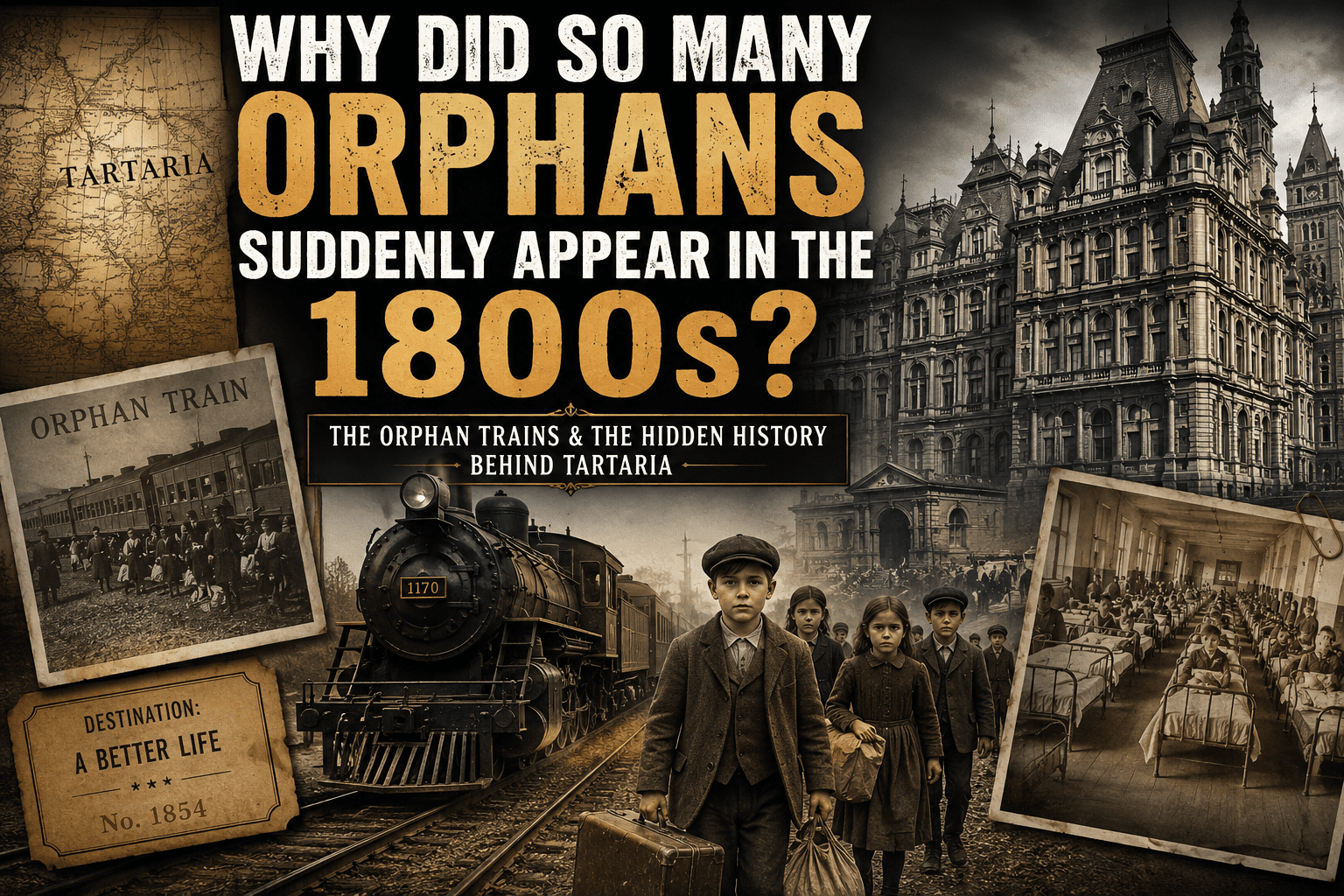
1800s Orphans?
Why Did So Many Orphans Suddenly Appear In The 1800s?
1800s Orphans: During the 1800s and early 1900s, something extraordinary happened across America and parts of Europe.
Hundreds of thousands of children were classified as orphans.
Large numbers of homeless children suddenly appeared in major cities.
And one of the biggest child relocation programs in history began.
These children became known as the “Orphan Train” children.
Official history explains this as the result of:
- poverty
- disease
- immigration
- industrialization
- overcrowded cities
- war and social collapse
But alternative researchers exploring Tartaria and hidden history believe there may be more to the story.
Some ask:
- Where did all these children really come from?
- Why were there so many?
- Why were they relocated across the country?
- Could the orphan phenomenon connect to a larger historical reset?
These questions have transformed orphan trains into one of the most controversial and emotional topics within alternative history research.
Let’s explore the mystery of the 1800s Orphans.
Recommended products
-
Tartaria Full hidden History Unlocked – Special edition Paperback Book
USD Original price was: 169.00$.59.00$Current price is: 59.00$. -
Tartaria Orphan Trains And the cabbage patch Children
USD Original price was: 159.00$.49.00$Current price is: 49.00$. -
Tartaria The book of images
USD Original price was: 299.00$.99.00$Current price is: 99.00$.


What Were The 1800s Orphan Trains?
The Orphan Train movement began in the mid-1800s in the United States.
According to historical records, organizations transported homeless and orphaned children from crowded eastern cities to rural areas across America.
Between approximately 1854 and 1929:
- an estimated 200,000 children were relocated
- trains carried children westward
- many were adopted by farming families
- others became laborers or servants
The movement is considered one of the largest child relocation programs in American history.
Official explanations point toward:
- extreme poverty
- disease outbreaks
- high death rates
- immigration waves
- unsafe city conditions
At the time, cities like:
New York City and Boston
were heavily overcrowded and struggling with homelessness.
Why Does The Topic Connect To Tartaria?
Within alternative history communities, orphan trains became connected to Tartaria for one major reason:
The sheer number of children involved seemed difficult for some people to explain.
Supporters of Tartaria theories began asking:
- Why were there suddenly so many “orphans”?
- Why do official records sometimes appear incomplete?
- Could these children have survived a forgotten catastrophe?
- Was civilization being repopulated after a reset?
Some researchers speculate that orphan trains may have been part of a rebuilding phase after the collapse of an earlier civilization.
Others believe many children may have simply lost records of their families during chaotic historical periods.
It is important to note:
there is no mainstream historical evidence linking orphan trains to Tartaria.
However, the emotional and mysterious nature of the topic continues attracting enormous interest online.
The Harsh Reality Of The 1800s
To understand the orphan train phenomenon, it is important to understand how difficult life was during the 1800s.
Major causes of orphanhood included:
- tuberculosis
- cholera
- influenza
- industrial accidents
- war
- malnutrition
- dangerous working conditions
Many parents died young.
Large immigrant populations arriving in America often lived in extreme poverty, especially in crowded urban neighborhoods.
Children frequently ended up:
- homeless
- abandoned
- in overcrowded orphanages
- living on the streets
Historical photographs from the era reveal harsh living conditions many people today can barely imagine.
The Mystery Of Missing Records
One reason alternative researchers became interested in orphan trains is because records from the period can sometimes appear incomplete or inconsistent.
Questions often raised include:
- Why were some children’s identities poorly documented?
- Why were family histories sometimes lost?
- Why do adoption records occasionally seem fragmented?
Historians explain this through:
- poor recordkeeping systems
- limited technology
- chaotic urban conditions
- inconsistent adoption processes
But for alternative researchers, these missing details became fertile ground for speculation.
Giant Buildings And The Orphan Theory
Another reason orphan trains became tied to Tartaria is because of architecture.
Researchers noticed that many orphanages, schools, and institutions from the late 1800s were enormous.
Some buildings appeared:
- highly advanced
- massive in scale
- richly decorated
- difficult to reproduce today
This led some theorists to ask:
- Were these buildings originally built for another civilization?
- Were existing structures repurposed after a historical reset?
Critics strongly reject these ideas, explaining that:
- wealthy industrial eras funded large civic architecture
- orphanages and institutions were intentionally monumental
- construction methods of the era are well documented
Still, the visual similarities between old-world architecture and Tartaria discussions continue fueling curiosity.
Why Did The Children Get Relocated?
The official purpose of the orphan trains was to give children better opportunities.
Organizations believed rural families could provide:
- work
- food
- shelter
- structure
- education
Some children reportedly found loving homes and successful futures.
Others experienced:
- exploitation
- abuse
- forced labor
- emotional trauma
The reality was complex.
Unlike modern adoption systems, protections for children were extremely limited during that era.
The Psychological Power Of The Mystery
The orphan train topic deeply affects people emotionally because it involves:
- lost identities
- forgotten children
- family separation
- historical trauma
- unanswered questions
Alternative theories surrounding Tartaria amplify this emotional impact by suggesting the possibility of:
- erased civilizations
- hidden catastrophes
- lost ancestry
- historical manipulation
Even for those who do not believe the theories, the subject remains emotionally powerful.
Social Media And The Modern Awakening
Platforms like:
- TikTok
- YouTube
helped bring the orphan train topic into mainstream alternative history discussions.
Videos combining:
- orphan train photographs
- giant architecture
- Tartaria maps
- buried buildings
- world fair imagery
quickly went viral.
Millions of people who had never heard of orphan trains suddenly began researching the subject.
This online curiosity sparked renewed interest in:
- forgotten history
- genealogy
- architecture
- historical archives
What Historians Say
Most historians strongly reject connections between orphan trains and Tartaria.
According to mainstream historical research:
- orphan trains were a documented social reform effort
- poverty and disease explain the large number of children
- immigration waves overwhelmed major cities
- architecture from the era reflects industrial wealth and craftsmanship
Historians also warn against mixing speculative theories with real historical suffering experienced by orphaned children.
This is why careful, balanced research remains important.
Why The Topic Continues Fascinating People
Despite criticism, the orphan train mystery continues growing online because it touches on universal human questions:
- Who were these children?
- What happened to their families?
- Could parts of history have been forgotten?
- How much of our past remains hidden?
People are naturally drawn toward mysteries involving identity, loss, and hidden truths.
And orphan trains combine all of these elements together.
Final Thoughts
Why did so many orphans suddenly appear in the 1800s?
The official explanation involves:
- poverty
- disease
- immigration
- industrialization
- social collapse within overcrowded cities
Alternative researchers believe deeper historical mysteries may exist beneath the surface.
Whether one views orphan trains through the lens of documented history or speculative hidden history theories, one thing is undeniable:
The story remains one of the most emotional and mysterious chapters of the modern historical era.
And perhaps that is why people continue searching for answers today.
Continue The Research
If you want to explore deeper into:
- orphan trains
- Tartaria
- giant old-world architecture
- World Fairs
- buried buildings
- hidden history
- lost civilizations
continue your research through the investigations and visual in the books below:
Recommended products
-
Tartaria Full hidden History Unlocked – Special edition Paperback Book
USD Original price was: 169.00$.59.00$Current price is: 59.00$. -
Tartaria Orphan Trains And the cabbage patch Children
USD Original price was: 159.00$.49.00$Current price is: 49.00$. -
Tartaria The book of images
USD Original price was: 299.00$.99.00$Current price is: 99.00$.
Explore:
- Hardcover Research Editions
- The Tartaria Book of Images
- World Fairs Investigations
- Star Forts Collections
- Hidden History PDFs
- Ancient Architecture Studies
Thousands of readers worldwide are already exploring the mystery for themselves.
Recommended products
-
Tartaria Full hidden History Unlocked – Special edition Paperback Book
USD Original price was: 169.00$.59.00$Current price is: 59.00$. -
Tartaria Orphan Trains And the cabbage patch Children
USD Original price was: 159.00$.49.00$Current price is: 49.00$. -
Tartaria The book of images
USD Original price was: 299.00$.99.00$Current price is: 99.00$.